| 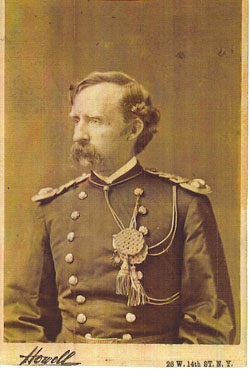 CUSTER,
George Armstrong, soldier, born in New Rumley,
Ohio, December 5, 1839; died on June 25, 1876.
After
graduating at West Point in 1861, he entered into
active service and took part in the battle of
Bull Run, and at Manassas, where he made his first
cavalry charge. He was assistant engineer in constructing
earth works at Yorktown, and went in pursuit of
the enemy with General Hancock. Subsequently he
was appointed captain and aid to General McClellan,
serving on his staff as long as he was in command.
In 1863 he became aid to General A. Pleasanton,
and was appointed brigadier-general. He served
with General Grant in the Wilderness, and with
Sheridan in the Shenandoah Valley. He also commanded
a cavalry division in the pursuit of Lee after
the evacuation of Richmond. After the war he was
made lieutenant-colonel with the brevet of major-general
and assigned to the seventh United States cavalry.
He served on General Hancock's expedition against
the Cheyennes and Sioux; but in 1867 he was tried
by court-martial for cruelty to his men and for
having left his command without permission. He
was suspended for a year, but in 1868, at the
request of General Sheridan, he was restored,
rejoined his regiment, and served against the
Indians. In 1873 he went with his regiment to
Dakota, and served in the Yellowstone expedition,
and in 1874, was sent to explore the Black Hills.
His report of the fertility and mineral wealth
of that region led to immigration and its encroachment
on the Indian reservation and caused trouble with
the Sioux, under Sitting
Bull. In 1876 General Sheridan ordered an
expedition to march against the Indians to settle
the troubles. This moved in three columns under
General Terry, General Gibbon, and General Crook.
General Custer led General Terry's column, and,
when reaching an encampment of the Indians on
Little Big Horn river, he divided his men into
three bodies and advanced with five companies.
The Indians concentrated their force upon Custer's
division, all the men of which, including General
Custer, were massacred on June 25, 1876. General
Custer was buried at West Point, where a statue
of him was erected in 1879. See The Complete
Life of Gen. G. A. Custer by Capt. Frederick
Whittaker (New York, 1876). His wife Elizabeth
B., is the author of Boots and Saddles (New
York, 1886), and Tenting on the Plains, or
Life with General Custer in Dakota (1888). CUSTER,
George Armstrong, soldier, born in New Rumley,
Ohio, December 5, 1839; died on June 25, 1876.
After
graduating at West Point in 1861, he entered into
active service and took part in the battle of
Bull Run, and at Manassas, where he made his first
cavalry charge. He was assistant engineer in constructing
earth works at Yorktown, and went in pursuit of
the enemy with General Hancock. Subsequently he
was appointed captain and aid to General McClellan,
serving on his staff as long as he was in command.
In 1863 he became aid to General A. Pleasanton,
and was appointed brigadier-general. He served
with General Grant in the Wilderness, and with
Sheridan in the Shenandoah Valley. He also commanded
a cavalry division in the pursuit of Lee after
the evacuation of Richmond. After the war he was
made lieutenant-colonel with the brevet of major-general
and assigned to the seventh United States cavalry.
He served on General Hancock's expedition against
the Cheyennes and Sioux; but in 1867 he was tried
by court-martial for cruelty to his men and for
having left his command without permission. He
was suspended for a year, but in 1868, at the
request of General Sheridan, he was restored,
rejoined his regiment, and served against the
Indians. In 1873 he went with his regiment to
Dakota, and served in the Yellowstone expedition,
and in 1874, was sent to explore the Black Hills.
His report of the fertility and mineral wealth
of that region led to immigration and its encroachment
on the Indian reservation and caused trouble with
the Sioux, under Sitting
Bull. In 1876 General Sheridan ordered an
expedition to march against the Indians to settle
the troubles. This moved in three columns under
General Terry, General Gibbon, and General Crook.
General Custer led General Terry's column, and,
when reaching an encampment of the Indians on
Little Big Horn river, he divided his men into
three bodies and advanced with five companies.
The Indians concentrated their force upon Custer's
division, all the men of which, including General
Custer, were massacred on June 25, 1876. General
Custer was buried at West Point, where a statue
of him was erected in 1879. See The Complete
Life of Gen. G. A. Custer by Capt. Frederick
Whittaker (New York, 1876). His wife Elizabeth
B., is the author of Boots and Saddles (New
York, 1886), and Tenting on the Plains, or
Life with General Custer in Dakota (1888).
New
Americanized Encyclopædia Britannica
(Twentieth Century Edition), 1907.
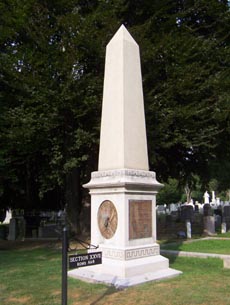
MAJOR GENERAL GEORGE A. CUSTER, colorful Civil
War leaders and Indian fighter, died with most
of his command at the Battle of Little Big Horn,
June 25, 1876. The base of his marker, originally
topped with a bronze statue, stood adjacent the
Headquarters Building. Mrs. Custer took exception
to the statue and had it removed. Subsequently,
the pedestal with the addition of an obelisk became
the grave marker for this legendary figure.
A
Walking Tour of the
West Point Cemetery
Pamphlet
distributed at the
cemetery, August 2005
Photograph
by Chuck Merkel
Numerous bibliographies have been published listing articles and books about George Armstrong Custer, so only a few select ones are offered here:
Article: "War With the Sioux: Indian Fights and Fighters; Part II – The Last of Custer" by Cyrus Townsend Brady • Pearson's Magazine • September 1904.
Article: "Custer and the Kidder Massacre" by Lawrence A. Frost • Before the Little Bighorn—another "Last Stand" with every trooper killed—only the General understood how and why. • Westerner • Vol. 2, No. 5 • September 1970.
Article: "Its Equal I Have Never Seen: Custer Explores the Black Hills in 1874" by Brian W. Dippie • COLUMBIA Magazine: The Magazine of Columbia University • Vol. 19, No. 2 • Summer 2005.
Article: "George A. Custer's Own Account of His Campaign Against the Sioux: The 7th Cavalry en route to the Battle of the Little Bighorn" by Bruce Brown • Astonisher.com • November 2, 2007 • Updated January 12, 2011 • Accessed August 13, 2025.
Article: "Custer: The Truth Behind the Silver Screen Myth" by Louis Kraft • Errol Flynn's portrayal of George Custer rings true in They Died with Their Boots On, even if the movie fudges the facts. • American History, Vol. 42, No. 6, February 2008, p. 26.
Article: "Autie & Libbie" by Jeffrey D. Wert • The marriage of George Custer and Elizabeth Bacon became a love story for the ages. • American History, Vol. 42, No. 6, February 2008, p. 34.
Article: "Christmas on the Frontier with the Custers (1865)" by Peter Russell • MenWithCuster.com • Accessed December 17, 2025. |


